
Denying the Purple
My attempt at fiction for Antelope Hill's writing competition, the theme being 'thinking about Rome.'

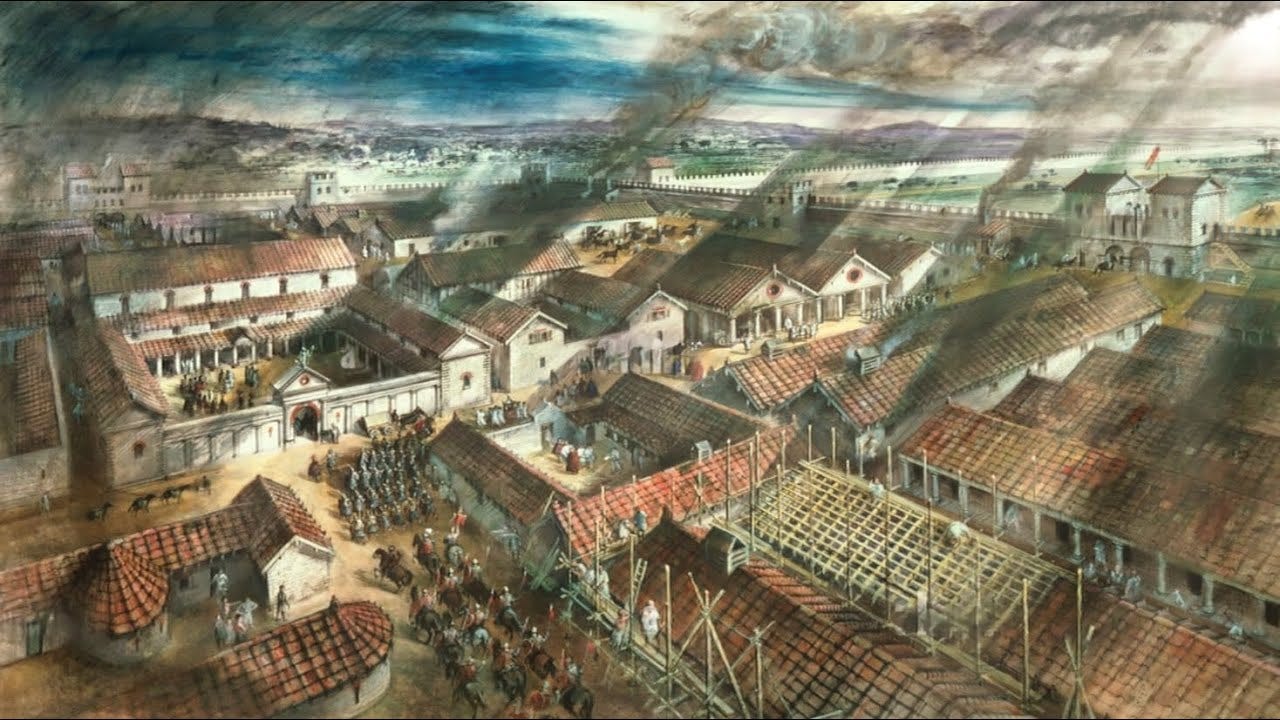
I was sent to aid my master, Decimus Lucius Valerius, in the reign of Honorius. My family had been with his a long time, and though I was a freedman born in Italy, the debts of patronage are great. I did not take well to Britain this time. My bones were old and the cold deep, even in the south, where the climate was kind. I went because I admired my master, and had since we were children, when I had first known this island. I went also because nobody else was willing.
In those days things were desperate, though they had been desperate since before my birth. My master, stationed in Dubris, was part of the imperial magisterial administration. His rank was Praefectus; he was born and lived in Britain most of his life. He was in his fifties now, but in his youth he had commanded men against the barbarians who invaded the province from all sides in that moment of great calamity. He spoke Latin with the accent of the north, which made his trips to Rome infrequent and embarrassing to his extended family. To him fell the maintenance of order in the harbour town and the fort. He was responsible for the cohorts encamped nearby, the classis that would dock, and the peaceful running of a town forgotten by Britain, in a province forgotten by Rome. I kept his accounts.
Titus Caelius Severus, Legate from Rome and barely thirty, had recently arrived and taken up quarters in our villa along with his staff. Severus and my master had nearly come to blows on occasion, despite their difference in rank. Severus had no official position, which rankled him; he was expected to return to Rome at year’s end to provide a report. His title was purely for leverage. Rome was nervous of Britain.
“You misunderstand my purpose, Valerius,” Severus had said, “I am not here to take your case to Rome. I am here to take Rome’s case to you.”
To this my master responded that he might find better lodgings in Londinium, to seek an audience with the proconsul who governed the entire province. About this Severus was quiet. The proconsul was known to be a glutton and fit for little else beyond table. Beneath him Britain had not flourished, though she had not flourished for a long time.
They rode the edges of the town, across the palisades with Severus’s aides and I in tow, to discuss the state of the settlement. It was summer and the sun high in the sky, and from the sea blew an unfavourable breeze that brought the stink of rotting kelp.
Shanties had formed along the walls, where Britons from far places cowered in lean-tos, and watched with slitted eyes as we passed. There are no nails, reported my master. Repairs are difficult. Locals loot ruined buildings and the iron foundries are ill-supplied. Little tax is collected. People from the countryside flood the town whenever an uncertain sail is spotted at sea. These people you see are from distant places and once ran their own townships, but they have come here in search of safety. The land has not been safe since the barbarian invasions thirty years ago. There are brigands and deserters that infest the inward parts of the province, who renew their numbers each year.
My master’s voice was like the creaking door that led to my quarters in our villa. It had creaked for years yet nobody paid it any mind.
“What of the cohorts?” Severus had asked. We arrived at the fort where the cohorts were stationed, the wooden stakes that walled the garrison decaying, the eagle standard unburnished in the hirsute hands of the signifier. The legions were stretched thin, detached into formations of varying strength along the coast. These were not men in their prime. We stood about as the Tribunus Militum, Constantine, led them in drill. He was a large, hulking man with the demeanour of a non-commissioned officer, despite his rank. He had been elevated, a fact for which his troops hated him. They could abide orders from a man of equite or noble birth, but bristled when it came from a commoner like themselves. But he was brave and ambitious and physically imposing and even Valerius, my master, had to pay him careful respect. The troops had deserted en masse in the north in the last time of great trouble.
If Severus was unimpressed he did not show it. Instead he spent much time looking over the books with the quartermaster and his bookkeepers. Valerius and I stood to one side as they discussed the strength.
“You know what this means,” said my master.
“Yes,” I replied quietly. They planned to denude our strength further. Almost all the formations of good standing had already been sent to Gaul.
We returned to the villa before sundown and I was tired from riding. I was out of shape; this was a leisurely jaunt around the town and yet my legs were sore. I sat with my wife and we dined in quiet. Valerius did the same, though he was a bachelor, and Severus ate with his own people. It was a maudlin evening to cap a maudlin day.
* * *
A week passed when panic gripped Dubris. Sails in the east. We assembled near the docks to see. I counted six ships against the morning glare. Already word had spread across the town and the cohorts had been primed. Constantine arrived with a detachment. My master stood with Severus beside him, like a dog that never left his side.
The tides were bad and the journey arduous. There was apt time for discussion, though nothing was decided. At last a single ship under a flag of truce drew up and the Saxon delegation mounted the wharf.
Their leader introduced himself as Saebert and was a man impressive to behold. He was tall and broad in the way Germans are. He held an arm in parlay; my master took it, though I knew from his demeanour he was not in a parlaying mood. In halting Latin, Saebert explained his purpose. He wanted to trade.
Furs, pottery, and metal goods for slaves and tin. My master was unconvinced. “You have the look of a raiding fleet.”
“Our people,” said Saebert, “do not trade or fight only, but both. For now, we want only peaceful commerce.” And he smiled with huge, crooked teeth, though he was handsome in the way that very powerful men often are. “We are only six ships. In number, we are not even a single hundred.”
“How do I not know there are a dozen more ships a league beyond, where we cannot see?” said my master.
“You cannot know that, as you cannot know many things,” he said, “but you have many soldiers. I did not think it was like Romans to be afraid.”
My master explained we had no tin, which was untrue, though Dubris was a poor place in these times. Once it had been Rome’s first step into Britain. Caesar himself had landed seven miles away.
“Might my men lodge here for the night?”
“That is not possible,” my master said, “and you will have better fortune southward along the coast.”
Saebert departed and we conferred. My master ordered cavalry patrols deep into the countryside north and south. He suspected they would land and form a raiding party. “But keep it quiet,” he said. “I do not wish for panic and general disorder.” He was thinking of food stores and the already-overcrowded population of the town. I was thinking that should we need to set to sea in a hurry, we would do so in pots and pans, on amphoras and dangling on lengths of rotting fencing. I looked at the docks and examined the fishing vessels there. There were no fleets due for some time and legitimate traders were few. Those men might be traders, but they had other trades first.
* * *
We convened later that day at the forum for a conference of the town’s worthies. They sat at table while we aides sat behind our masters to shorthand the minutes. With us were the magistrates of the town, the bishop of the see, the important men of commerce, and the other officials who held various positions as vicarii. My master was in a foul mood; hosting Severus, and the arrival of the Saxons, had set upon him darkly.
“That was reconnaissance,” said Valerius. “We must strengthen the town’s defences without letting word spread. If we do, we will be flooded with mouths to feed.”
The bishop, an older man of known irreligious habit, clasped his hands in front of him. Long had he and my master jousted on the best way to manage the porous edges of the civitas. He favoured whatever approach would flummox Valerius. His arguments were sophistic and often persuasive. “This will sit poorly with the local villages and pagi. If they know that raiders are in the region, and we make no mention of it, they will look to their own interest.”
“Their own interest is our interest,” said my master, “and neither is served by choking the roads and abandoning their crops, for a threat that may not materialise. The Saxons often cross into our territory undetected and have their own networks and friendly people with whom they deal. We needn’t cause unnecessary panic.”
“If your fears are not misplaced, many may be killed and enslaved,” said the bishop, “and the Saxons are pagans who do not observe civility.”
“Then I hope you have your weapons ready.”
“It is not like our grandfathers’ day,” said the bishop, “we must accept that we Romans cannot alone hold Britain, and even the levies from the friendly local peoples are not enough. Might we offer Saebert and his men employment? After all, Stilicho himself is a Vandal.”
“Better to hire wolves as shepherds,” replied my master. “When they see that we cannot pay our own men, what do you think they will fight for? Our good graces are not worth a sestertius to them. The day I take military advice from a clergyman has not yet come.”
“Some battle order would do my men good,” said Constantine, “they are raring for it.”
At this my master’s face turned a shade of purple. “Your men are drunks who spend all their time in the brothels. That drill you put on the other day was shameful. They are an insipid lot –.” He stopped short of saying what I knew he thought: they come to resemble that which they behold.
“My men have not received their pay in six months,” said Constantine, who had turned white in turn. “I will not have my name besmirched.”
“The men who fought with the great heroes of old did not see their money for years,” my master continued, now in a temper. He had advocated long for the arrears of the men; to have it now pretended that this was his doing threw him into a rage. “And they did more than sit around a guardhouse playing dice. They are fed and housed. And they ply other trades. This is known.” He turned to Severus. “You see now what threats arise when we cannot pay the men entrusted with our defence? They become smugglers and racketeers in the time remaining to them, when they are not playing at farming.”
“They will fight if called upon,” said Constantine, white as a sheet.
“Doubtless,” said my master, and he paused. He left unsaid what needed no saying.
“Perhaps,” interjected one of the merchants, a fat tin mogul called Verres, “we might have benefitted from trade.”
“They were not traders,” said my master, who was beginning to become exasperated. “Must you only think of your pockets?”
Verres shifted in his seat. “I am thinking not only of my own pockets,” he said, “but the pockets of our townspeople, which, as you have noted, are empty. There is no more commerce. Fewer ships make the journey from Gaul. My warehouses are full of unsold goods and I am far from the only one.”
At last my master tired of the back and forth. He asked Constantine if there was news from the cavalry, the first of whom would be sending back word when they changed horses at the way stations on the limes of the civitas. There was not. Perhaps the Saxons had gone, but I could see that he doubted it. He ordered they be ready, but held off on ordering the civic authorities to do anything. “Drill the men,” he said to Constantine, “they need to be fit.”
* * *
The meeting broke up and a grim mood descended as we departed back to our villa with our escorts. “A fine council you have,” said Severus, along the way, not caring that I heard. “It is obvious you loathe them. How can you make this town function without cooperation?”
“The religious leaders wish to become political leaders,” my master said, “and the merchants think the only metal in the world is minted into coins. If I left tomorrow, this civitas would be broken up and gone the day after. If you think I am talking pridefully, then you have spent too much time in Rome.”
At this Severus baulked. He had learned something about Valerius, something he had not guessed. I knew my master was speaking frankly. I had watched middle-age consume him; a career, once bright, lost in the administration of a place that everybody had forgotten. I knew his qualities well. He was spartan in personal vices, read philosophy regularly, and clung to the old virtues of Rome. In this he was a romantic. He still believed that, far away, men of virtus conducted affairs of state with honour. Had I shared his rank, and not respected him so much, I would have laughed at his naivety. Something of the old virtues had been preserved in him, born and raised far from the eternal city, centuries too late. I had read Virgil and Livy too, but knew that was history.
“That tribune, Constantine,” said Severus. “Do you trust him?”
“What choice do I have? I turn a blind eye to the men because they have gone unpaid. They have no love for Constantine, that is known. But he is clever with them.”
“Would the men follow you, should the need arise? And the rest of the legion?”
“Without question,” said a voice, and I realised it was mine. Both men turned their heads in surprise.
“Your freedman has a high estimation of your qualities.”
“He should,” said my master, “it was my family that made him so.” And they laughed, in the way that men of rank do. But I caught the look of gratitude that passed from Valerius to me, and I knew then that he felt more vulnerable than his temper betrayed. It was night by the time we returned, and the household staff stood on the threshold awaiting us, cast in amber by the lights they held. I felt a sudden pang for this place, which was now my home.
* * *
A spy was caught the night following. It was a lucky thing; my master’s own men had received him, collected by the picketing cavalry who had returned late. He had been caught skulking on the road leading to the town. He had run when confronted, was ridden down, and spoke no local dialect the men had ever heard. They had delivered him directly to Valerius, in hope of a reward; lean men on nags who received a bag of coin for their trouble.
He was a Saxon, of that there was no doubt. We stood around him in a darkened corner of the room in a corner of the villa. The staff were scattered; we wanted this quiet. For this work my master called in the head of his security, an ex-gladiator he had acquired long ago. The man was called Milo and was covered in scars. The sight of him was enough to turn milk.
The Saxons had landed, though the spy’s business was, he declared, more exploration than espionage. They were not there to raid, but to find markets. Dubris had been denied them, but in the hinterland there might be people willing to trade. This we doubted. Milo expressed this with a series of blows. Was he taking a message? If so, to whom? All men have a threshold of pain, but his was high. If there was a message, he did not share it. “If you are lying,” said my master, “I will crucify you.” He made the gestures so the man understood, the universal language of the finger across the throat.
* * *
We rose early after passing a poor night of sleep. In the morning Valerius, with Severus and I in tow, arrived at the fort. He gave his orders to Constantine, who stood at attention. He looked more centurion than tribune.
“They have landed seven miles away,” my master said, “where Caesar himself landed.” He laid out the order of battle, emphasising the cavalry as his eyes. He was patient; he thought Constantine a dolt, and Constantine appeared to return the sentiment. People forgot Valerius was once a military man, and a very good one. “Leave two centuries with me within the town proper.”
“Two? That will leave me badly understrength.”
“If they are in great number, form a defensive position and send back word. I will summon the nearby formations and march to your aid. Leave your first century here, and a second of your choosing.”
The first century was the best century, the one composed of the most fit and able troops.
“You will not come yourself?”
“My place, for now, is here.”
Constantine shifted. “The men would admire your presence.”
“Constantine,” said my master, “let us not pretend we are friends. Are you afraid of the Saxons?”
The expression on Constantine’s face gave away his deep dislike. He collected himself. “We will set off immediately. Expect riders with news by noon.”
“I shall.”
We departed, expecting the two centuries to arrive in the town proper within the hour. My master was perturbed. Sometimes he confided in me, rather than merely handing me instructions. “He expected it.”
“My view?” I asked. He nodded. “Perhaps he is cleverer than you give him credit.”
“Constantine? Never.”
“I think you underestimate him. I think he has been underestimated all his life.”
“Then let us hope the Saxons underestimate him too.” It was, I knew, the conceit of his class, and the secret plea of mine. We could never be equals in rank, but I would never love him less for it; and nor, I think, he I.
The day passed. There were no riders from Constantine. My master summoned the council, and the mood was dark. The bishop pleaded for peace; Verres pleaded for trade; Severus said nothing, though I was sure he was beginning to resent his assignment. It was a continuation of the previous conference. Nothing was decided; if my master had hoped for support, material or spiritual, none was forthcoming. The two centuries bivouacked in the market square. We waited as the afternoon grew long. My master had sent messengers to the nearby forts, but any relief was at least two days away. Word spread among the townspeople that the cohorts had been massacred, that the Saxons were coming, that the city would be sacked. People began to pile up their goods, but there was nowhere to run except into the countryside.
* * *
By nightfall riders were seen at the furthest reach of a man’s eye, but they were neither Romans nor Britons. Scouts returned their reports; Saxons on the road. Many hundreds. Valerius called council.
It is clear, he said, that Constantine was defeated or had deserted his duty. All city men of fighting age must be ready to make an account of themselves.
The centuries were deployed along the palisades, built in the old fashion of the hill-forts that once dominated the region. I knew for many years Valerius had wished to rebuild the walls of stone. They had gradually been scavenged into ineffectuality after their destruction in the invasions three decades ago. Others would pay the price for the problems of insufficient labour and abandoned quarries in the diocese of Britannia Maxima.
“We must seek terms,” said the Bishop, “will not you, Severus, Legate of Rome, see sense in this?”
My master was on his feet. “We will defend the city. That is our duty as Romans. I will hear no further talk of surrender.”
“Severus,” said Verres the merchant, “you are the man of rank here. What do you say?”
Valerius nodded to the two centurions in the room. They took a step forward. He held up his hand. “No sedition will be tolerated. I invite you out of courtesy. This is a military council, not a civic meeting. Verres, you have many slaves and freedmen under your employ. It will be of use if you organise them and send them to the decurions. Bishop, the people look to you for guidance. Lead them in prayers for the city, but no talk of terms. You yourself said much of the savagery of the Saxons. You are old enough to remember how it was.”
“Many of them are Christians now,” said the Bishop, “and many have likely served in the legions before. They are more like us than you think.”
I saw that as the strength of the cohorts had been stripped, so too had the authority of my master. It was late and he was tired. The civic authorities had no stomach. Tomorrow we expected the Saxons would be before the town in full strength. Our best hope was that our messengers had made it to Durovernum and Anderida. Otherwise we would die in the dark.
* * *
We needn’t have waited; the dark came to us. The Saxons made for the gates in the hour before dawn, but the centuries were ready. We met them at breaches they forced; we fought them in the streets; they did not torch the houses for hope of plunder. They fought like Romans, in formation, but they were limited in manoeuvre. They were bottled at the gate and breaches the size of a man, where not an inch could be given lest it become a mile. Surprise was their weapon, but it proved blunt. My master directed the men, as though he were leading a legion. Across from him was Saebert. There were no arms in parlay this time. My master exhorted the men to die good deaths, and they obliged in the quiet order that is the birthright of Roman arms. I was told the howls of the barbarians brought early labour to the pregnant women and stopped the hearts of old men.
In truth of this I can say little. I was entrusted with my master’s household. I worried that my wife, though no longer young, would become spoils. I would sell myself dearly before that moment; it would be my own quiet heroism. I waited for word. Severus fought with my master. He fought well and bravely, but no man with the rank of Legate dare do different.
The bishop goaded a crowd on the other side of the town to prepare gifts for the Saxons. When I heard I sent Milo, sulking that he was not with my master, to put a stop to it. The crowd set upon him and he barely escaped with his life. I began to think the city unworthy of my master.
When dawn arrived we saw more men assembled outside the town. Dull gleam, visible from the villa’s roof, revealed chainmail and plumed helms. It was Constantine’s cohorts. They waited in good order, but they did not advance. I cried impotently from the roof. Move, you dogs! Yet their presence cheered the men who, despite heavy losses near the gate, fought harder. The Saxons were unsure; they were in the trap Vercingetorix laid for Caesar, but they had neither his mind nor his mettle. At last Constantine signalled the advance. The Saxons broke, and the cavalry formations ran them down. It was over by midmorning. The men went through the streets, rounding up stragglers who had survived the rout. There was no mood for quarter. The barbarians were butchered like wild beasts. Constantine led the effort and by day’s end his armour was smeared with blood. He made a fearsome sight.
* * *
Severus made a show of it. He at last flexed his rank, and Constantine was elevated again, the saviour of Dubris. For this his men cheered; there is no cure for the hatred of a commander better than success.
Verres, I am told, purchased the fishing fleet at an outrageous price and set to sea with the goods that he could load. His men were too busy to be sent to the decurions, loading tin and stores as their fellows died mere blocks away. He departed. They say there were Saxon sails on the sea; I never heard what became of him, though it would be a suitable fate if he were to become the object, not the subject, of his beloved commerce.
Afterwards blood was hot. Saebert’s body was displayed in the square. The bishop, hiding inside his church, was arrested. My master knew it would not hold, that the ecclesiastical authorities would not tolerate it. It was an act of futile retaliation for his obvious collaboration.
Severus and he sat down across from one another in the villa when the business was concluded. It was late in the night; the sound of men drinking throughout the town could dimly be heard on the wind. Both men were exhausted, in the fragile state of mind that follows great danger, exertion, and excitement.
“I hope you have decided,” said my master, “what you will tell Rome when you return.”
“It was a victory of Roman arms, like in days of old. A small victory, but a worthy one.”
“It was nothing of the sort,” said my master. “You have elevated Constantine. A man more unsuitable I struggle to imagine. He should be broken by the rods for his conduct; if you were not here, that is the business I would be about now.”
“On the contrary,” said Severus. “He is a loathsome sort, that is certain. Any loyalty he generates will be short-lived. He has the natural cunning of an animal, but little more. This means he is safe.”
My master was enraged, as these days he often was. “You were present, as was I. He had every opportunity to intervene earlier. The battle should have been fought seven miles from here! He was part of a conspiracy to take the town, and only aided us when the Saxons were already broken. He was waiting to see the way things went. He, the bishop, and the merchants; if they had not a conspiracy of deed, they had one of thought.”
“Valerius,” said Severus, “you are a damned fool. Have you not realised why I am here? I am here for you. This province has produced too many usurpers, men who take the purple as they please. It is a hotbed of dissent and ambition. It is men like you – honourable men, men who other men follow – who menace Rome in our time. Your reputation is great, far beyond this island. Have you not wondered why your star never rose? Those men today would follow you to the world’s end. And that is the sort of man Honorius fears.”
There was silence at the table. Severus looked my master in the eye; my master looked to the floor. “What Rome is this,” my master said quietly, “where good men are regarded foes and wicked men friends?”
Severus sighed and stood up wearily. He looked far older than his thirty years. “This is the Rome we have. We are not reading Plato. We must deal with the world as it is.”
“Where the heirs of Catiline are celebrated?” said my master, voice rising, “where the old virtues are inverted?”
“You have spent too long on this island,” said Severus. “I speak to you now man-to-man. You have not been to Rome for many years. Spend some time there, and you will find your thoughts different. Perhaps it has always been this way. I will tell them in Ravenna you are no threat to Honorius. Do not make a fool out of me.”
“Still I am not trusted!” my master replied, his fists on the table. “Do me one favour. Take Constantine with you when you go. Send him to Gaul where the barbarians are said to be massing along the Rhine. I do not wish to have his stink near me.”
“That,” said Severus, “I can grant you.”
* * *
My master and I grew old in Britain. Constantine crossed to Gaul and claimed the purple. His revolt added weight to the death throes of Honorius’s reign, though at last his head was presented to the Emperor on a pole. Of Severus, I heard no more; perhaps he paid a dear price for elevating the wrong man.
Conspiracy was everywhere. Men looked to their ambition, when they were not looking to their appetites: when they were looking to anything at all, aside from sails at sea. There were always sails at sea. I knew that when my master and those like him passed from the world, the sails at sea would be at sea no more. How fragile a thing, our civilisation, a thing that dies in the hearts and minds of men long before the walls crumble, before the coffers empty, and before the traitors rise.
Author’s notes:
While Honorious moved his court to Ravenna in 402AD, it makes sense to refer to ‘Rome’ in the general sense that people today use it (and many contemporary commentators did as well).
While Constantine III did attempt to claim the imperial throne, he did this before moving to Gaul. His revolt lasted quite some time and for a while he was recognised as co-emperor, though whether he was actually a common soldier or not is disputed.