
Not a Bad Public

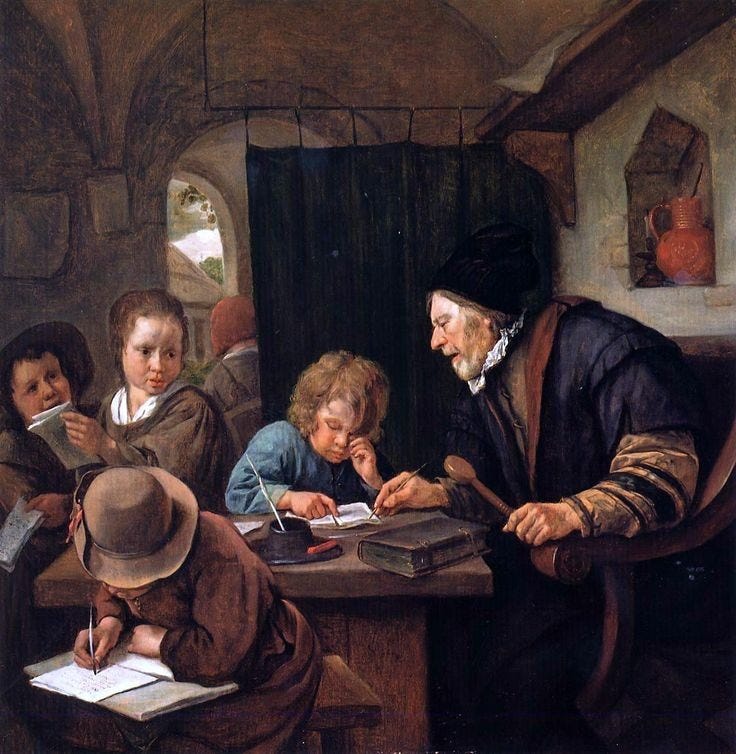
In an age where nobody has much to say about teaching that is terribly edifying—a view I largely share, I am afraid—a sterling defence of the once-noble profession, that like so much else in our present moment has lost its soul, must be occasionally mounted. And, in an age with so few affirming things to be said for our present milieu, one must orientate oneself upward from time to time. Sound advice is to be like the bee, and find the honey where you can. I sometimes wonder what good it does to shout into the void nonstop, even if feeling a sense of justified anger can be cathartic, even pleasurable, notwithstanding if nobody pays you any mind. C.S. Lewis said that if you cannot find something to love, the next best thing is to find something to fight; and with enemies enough to fight, it is essential to have something to love, too. Teaching, a profession that is ultimately about love, is a good enough place to start. The profession, having drifted from its roots, is in dire straits across the Anglosphere; in the United States, three quarters of the states cannot fill classrooms. In my own country, Australia, the shortage is even more chronic. Nobody, it seems, envisions themselves as a latter-day Mr. Chips, and this seems to be the case from early childhood to post-graduate education. What has happened, and what ought to be done, demands attention.
The fact is that everybody knows what good teaching, and equally bad teaching, looks like. We have all experienced dozens, if not hundreds, of teachers over the course of our lives. Most are likely unremarkable, though there are those exceptions, exceptions that run in both directions. We all have a story about the teacher who merely passed the time between holiday breaks, the sarcastic teacher who took out their pet frustrations on a captive audience, and the teacher who, on the other hand, oriented us toward something profound. There is something rare, and unequivocally special, about the teacher and the class united in direction and purpose, like a ship with a full sail behind a unitary breeze. If we are lucky, we have experienced that once or twice, and we might have gained more than knowledge alone, but the sense of something communal, a shared journey that is so often absent in the twenty-first century world. This is the other gift teaching ought to give the world, if done right—an anchor in a world that disdains anchors. Outside of prison, the school is likely the only nonvoluntary community most young people will ever belong to.
There are a few works that have influenced my view of teaching. The first is Gilbert Highet’s The Art of Teaching, published in 1950. Others include A Man for all Seasons, the really wonderful play by Robert Bolt, adapted for film in 1966; and some honourable mentions go to the R. F. Delderfield series To Serve Them All My Days, begun in 1972, as well as Brain Moore’s Black Robe, and Solzhenitsyn’s For the Good of the Cause. In these works are bits and pieces that might help to work a remedy against the poison that has overtaken the profession in recent times.
The Art of Teaching is a wonderful remedy to the sort of pseudo-intellectual jargon that masquerades as educational theory today, and this is immediately obvious from its title, which does not pretend that there is anything terribly scientific about teaching. Oh, there are arguments that can be made about cognitive load and attention spans, and how to activate various parts of the brain, but the truth is that one can be a perfectly good teacher having never heard of any of those things. Anybody who has existed in the world for a span of time, paying any kind of attention, is aware of those things we know, without knowing their names; and how to transmit knowledge, from one vessel to another, is something we give and receive often before we are cognisant of our own existence. Much of what makes a good teacher is innate. You can read all the books on neuropsychology you like, and find that it doesn’t improve a student’s success one iota. Other attempts to quantify teaching in scientific terms, to make it circle around datapoints, effect-sizes, and graphs that fly about this way and that, are guaranteed to kill the thing as surely as a stake to an undead heart. The teacher who aims to deploy the latest strategy they learned at a professional development day has already been duped by the slick marketing and stamp of authority that is part-and-parcel of the Professional Development Industrial Complex. Much goes into marketing education consultants and their pseudo-scientific work, because education departments with large budgets and collapsing standards need silver bullets, and there are plenty of snake oil salesmen on hand with suspiciously full bandoliers.
To anybody who has been marinated in the soulless and increasingly corporate langue de bois of the zeitgeist that surrounds contemporary education, The Art of Teaching is a breath of fresh air, written with something resembling the cadence of a renaissance man, a product of its time and better for it. Most of all, Gilbert Highet has a deep and complex understanding of human nature, the sort that seemed to be commonplace for men of his time, and utterly absent now; I will try not to spoil his book too much. What has replaced it, and leaked into the entire schema of modern schooling, is part-Rousseau, part-Marx, with a sprinkling of Freud and the behaviourist psychologists who followed him. It is this we should explore before we look to Highet’s wisdom.
Modern educationists, at least since John Dewey, have intellectual roots deep in the Romantic movement that preceded them by a century, and in the corollary notion that people are spoiled by civilisation, rather than the reverse. All children are now the descendants of Rousseau’s Emile, about whom he coined his famous line: Everything is good as it leaves the hands of the Author of things; everything degenerates in the hands of man.
The modern education system across much of the West, premised on this idea, has suffered a gradual crisis of authority. This is because all authority, according to this version of human nature, is a Very Bad Thing, and puts those who want to run schools and classes into a terrible bind. They are never quite comfortable with their own position, believing, as many do, that the cure to all social ills is a shoddily-defined demotic egalitarianism. This is why academic articles from educationists are full of notions such as the democratic classroom, the teacher as facilitator, and other claptrap that is really a motley metapolitical theory masquerading as something that might be useful in front of a class. The problem is that institutional power does not disperse, it pools, and if does not pool in the hands of those who should wield it, it will do so elsewhere; say, in the hands of the rampaging gang defacing the toilets every lunchtime. We might expect the young to have an instinctive view of all authority as tyrannical—but the teachers?
If everything degenerates in the hands of men, then the lightest touch possible ought to be how we manage things. This explains the emphasis on ‘student-centred learning’, which defaults to letting Google do the job, and loose to non-existent behaviour management in many schools. The latter, above all else, is driving many from the profession in droves. If you listen to the general discourse on the subject, you will hear many praising the poison that’s killing them. One strategy to improve behaviour is called “Positive Behaviour for Learning,” which aims to replace mean-sounding words with nice ones. “Don’t punch little Jimmy,” is replaced by, “we are nice to our peers in this learning community.” For ideologues that have enjoyed such success manipulating language in the past, it should be unsurprising that this is the recommended course of action. If you are the vulpine sort of adolescent who smells weakness at an instinctual level, you’re in for a feast. There is something liberating, but also terrifying, about realising there are no real adults in the room. It’s a little like swimming out of your depth and then realising you can’t tread water terribly well. This is where we abandon our “at risk” youths, by being too afraid to deal with wickedness in a forthright way.
Adjacent to this is the lack of an objective ethical framework, passed down to the young, by which one ought to operate—outside, of course, the vague parameters of inclusion, diversity, equality, etc. These are better rendered as political slogans, designed to flush out those who are outside the flock, rather than a code for life, mind; as a result, the only way to make moral arguments to the young is through a consequentialist lens. You shouldn’t do x because y might occur is the best many can manage, any deontological notion of the good being good for its own sake being abandoned. If positive arguments for x can be mounted, then you’re in a little trouble, and there’s a reason sin is considered to be original, Emile aside. Human beings are rather good at making those sorts of arguments.
This is deleterious, because it makes the moral education of the young, like their education in various disciplines, entirely utilitarian in character. We are ‘outcomes based’, even if we change the language every few years. The risk is that we encourage latter-day Thrasymachuses among the young, who swallow and propound the notion that rules are only there to benefit certain quarters, that being immoral for one’s own advantage is hardly immoral at all. That this has in some quarters become a governing ethic for many should surprise nobody.
“The real duty of man,” says Highet, “is not to extend his power or multiply his wealth beyond his needs, but to enrich and enjoy his imperishable possession: his soul.” A better rejoinder to a utilitarian approach to education can hardly be imagined. Compare this with something by John Hattie, who is probably the most important educational theorist today in Australia: “What does matter is teachers having a mind frame in which they see it as their role to evaluate their effect on learning.” In the juxtaposition of those two lines, you can see everything that has happened; you can see that the life has been squeezed from the thing, and that what remains is a Frankenstein’s monster of stale clichés, of pseudo-scientific linguistics, the reduction of the thing to a spreadsheet rather than an artwork. There’s nothing in it to lift the soul, and it confirms Highet’s proposition, that “a scientific relationship between human beings is bound to be inadequate and perhaps distorted.” He concludes on the following note: “You must throw your heart into it, you must realise that it cannot all be done by formulas, or you will spoil your work, your students, and yourself.” We might as well make that the epigraph to all the recent efforts by education departments, who have pulled things in the opposite direction.
Read Highet’s book, if you want to know what teaching should look like, and if you believe, as I do, that it is essentially unchanged in character, method, and substance since before Socrates. Through his work runs a deeply humane spirit, one that reflects the truth, that teaching is essentially an art, and not a science; that the young require order, and that we ought not to be sentimental about it in silly terms, as the romantic types have managed over the past few decades. A world of natural anarchists, as Highet notes, is impractical now; as is a world full of men with nothing they can do well, and women who make love without realising it means children. It is good medicine, to read something from a time sure of itself.
A Man For All Seasons might seem an odd choice, written as it was about Sir Thomas More in the age of Henry VIII. Yet I return to it—or rather, one exchange from it—to explain why teaching ought to matter, especially when one runs into an old colleague from another life, or from university, who might look upon the teacher—whether changing nappies in daycare or a lecturer at university—as somebody content to live life in the slow lane. In this particular exchange, Sir Thomas More is counselling his protégé, and soon-to-be betrayer, Richard Rich, who is keen to advance his career via what amounts to selling his soul.
Sir Thomas More: Why not be a teacher? You'd be a fine teacher; perhaps a great one.
Richard Rich: If I was, who would know it?
Sir Thomas More: You; your pupils; your friends; God. Not a bad public, that.
Not a bad public, indeed. Who would know it, and its unspoken ancillary, who would respect it, is a sticking point for many who look at teaching for a moment and then disregard it forever as a potentiality. Kim Beasley Senior once declared that the Australian Labor Party had gone from being composed of the cream of the working class to the dross of the middle class, and it seems something similar happened to teaching over the course of the last century. Much of this had do with those formidable pre-second-wave-feminism women, who, like my own grandmother, were attracted to teaching, and brought the sharpest wits and most indomitable wills to the world of chalk and blackboards. Many of that sort, assuming they can be formed in our present milieu to begin with, might now be snapped up to work in Human Resources or become influencers or something similarly frivolous; too often the woman now attracted to teaching is the type suffering a form of arrested development. The post-war generation of men, many of whom were citizen-soldiers who went into teaching, provided a similar kind of granite to the schools, and it seems they were largely replaced by facsimiles resembling something out of Malcolm Bradbury’s The History Man by the 1970s and 1980s. In short, teaching went from being the cream of the middle class to the dross, the profession managing a sort of collective downward social mobility in the span of a few decades. This was nowhere plainer than in the Anglosphere, where in the wake of our post-war boom, it can be difficult for the general public to respect a profession that produces nothing, or at least, produces nothing without a twenty-year incubation period. Teachers are often looked at as also-rans, those who couldn’t do. One must shrug one’s shoulders at this sort of thing. Somebody taught you to read, after all.
Part of this we might put down to the increasing universalisation of schooling, which has done wonders for women’s mass employment, though perhaps without bringing about the age of unanimous wisdom its architects intended. Teaching, as part of this transformation, became a mass profession, and the first casualty a mass profession accrues is the broad expectation of excellence. It is hard to forget the most forgettable teachers, ironically, for exactly that reason. In Australia, there is much hullabaloo about the low standards required for university entry among those who undertake education degrees. The reality is in the numbers; warm bodies are required, for reasons of duty-of-care, and so that parents can head off to build the economy unencumbered by thoughts of child-reading. As an added bonus education, as a tertiary discipline, has few overheads, thus serving as a license for those neo-liberal businesses we once called universities to print money. Then there are the teaching unions that, while it must be said have done a great deal for improving the salaries of a profession traditionally regarded as poverty-stricken, have not done such a wonderful service in terms of the high regard the noble profession once enjoyed. They are part of the reason it is so difficult to dislodge non-performing teachers, and why attempts to improve the profession, broadly speaking, come unstuck.
For these reasons and others, teaching enjoys a much-reduced status, especially when compared with East Asia, where the teacher is often regarded, as once was the case across the Occident, comparable to the doctor or the lawyer. And for he who wishes to take himself rather seriously, teaching has a further natural hurdle: your day can be utterly ruined by a thirteen-year-old. They will find your weaknesses, that is certain, and for those who struggle to win over young minds, teaching becomes counter-insurgency before anything else. In the English-speaking world you must convince them to accompany you on the journey, rather than push them into cattle-cars, and this comes back to how innate what makes a good teacher truly is. There is a limit to how much you can teach a teacher, especially one who comes convinced of his own self-importance. It is of no help whatsoever that our general ethos, that disdains all the things that lend themselves to an appreciation of healthy authority, leave the individual teacher relying on the persuasive power of her personality, a power never distributed evenly.
Thus we can empathise with Richard Rich’s lack of enthusiasm, one that has only sharpened in our own time. Solutions to the problem of teaching’s poor image are predictable: offer more money, even as budgets creak, or do some hard marketing. We seem to think marketing is the solution to all our ills, as befits a truly consumerist society; it amounts to a belief in the sovereign power of trickery. A positive public relations campaign, that extols the virtues of teaching, is difficult to imagine, because the secret rewards of teaching are intimate, hard-won, and difficult to express to those who do not know them. The best I can imagine is an internet advertisement featuring a smiling middle-aged woman, surrounded by cheerful children, saying something like this: “I love that I get to make a difference. I can advocate for social justice and know that I am working with like-minded people. It helps that the pay, conditions and holidays allow me to live the lifestyle I choose.” You can imagine the sort of heart this pathos might move.
The inherent nobility of teaching is that it is one of the few accessible callings one can find that enjoys a spiritual element in an otherwise entirely secular environ. Highet entreats the teacher to be a little higher than the actor with his audience, a little lower than the priest with his congregation, a little gentler than the officer with his unit. With it comes the sense of building something in others, not only in individuals but a collective, something that hinges on the past, as well as the future, something that is selfless to an extent, when done right; a thing that the contemporary disposition, oriented in exactly the opposite direction, cannot well understand let alone embrace. It is not merely about “preparing a generation to be twenty-first century learners” in that purely utilitarian sense, which is a secondary concern despite what the educationists would have you believe—that the prime purpose is to create nuts and bolts for the economy depending on their wont. Rather, it is to put the young in their proper context, as part of something beyond themselves, even as we do a terrible job of it. Those who run the show like to pretend that’s not what it’s about, because the postmodern is determined to wreck everything prior to him, out of envy of that which dares exist in opposition to his will. Nonetheless, this inherent purpose in schooling outs, as we cannot escape the fact that all of us belong to something we didn’t choose. The schools once understood this role; that they have abrogated their duty toward it, in favour of acting as gigantic indoctrination factories for a new and prescriptive notion of what society ought to be, means that the conservative teacher, even in ostensibly conservative private schools, will always feel at odds with the organisation to which he is bound. He ought to remember he owes his dues to higher loyalties.
Sir Thomas More rebukes Richard Rich in A Man for All Seasons, after he betrays him for the position of Attorney-General in Wales: “For Wales? Why Richard, it profit a man nothing to give his soul for the whole world—but for Wales!” We could say the same of those ambitious-without-merit types who clamber up the greasy pole in educational leadership, who desire desperately to exchange the difficulties of the classroom for those of the staffroom, and who forget that the core purpose of the school is essentially a spiritual one. The calling is one of mutual edification, one of the few that exist any longer, where you can sleep soundly at night knowing you are working toward the Good. Don’t turn it into what it isn’t—some wan copy of the corporate or bureaucratic world, another careerist pursuit in a world hollowed out by too much of that—or you’ll reduce the thing yet further.
One thing to be said for teaching is that, aside from those careerist examples, it encourages people of goodwill and purpose, even those enslaved to bad ideologies. Certainly, teaching serves as a curative to the soul, a process best represented in the R. F. Delderfield series To Serve Them All Our Days. In the first book, a badly traumatised veteran of the trenches arrives, complete with shellshock, to a new school, to begin his post-war professional work. Over the course of the series, he is rebuilt as a man.
Teaching is, at its heart, a profession borne out of agape love, and the teacher who does not accept this, who does not love young people, individually and in groups, will struggle his whole career. Fortunately, while we can dispense with the notion that the young have any special moral insights, we can agree that they do not carry the rusted-on vices of years and decades that we grown-ups bear. While we are aiming to invest in them, we might find they invest in us, too; that the transmission is two-way, that they will work a restorative effect on you, as you work to build their minds. I am always reminded of the bishop in Les Misérables, who ransoms the soul of Jean Valjean:
Jean Valjean, my brother, you no longer belong to what is evil but to what is good. I have bought your soul to save it from black thoughts and the spirit of perdition, and I give it to God.
This is the power of goodwill, between one human being to another, bought at a certain cost of self-sacrifice; and few professions allow this sort of thing any longer. It is not something you can write into policy, as mercy requires justice to balance the scales, and an attempt to show “Unconditional Positive Regard,” as in many places has become school policy, is bound to be exploited by those vulpine types, to the detriment of everybody else, particularly those who must live at eye-level with them. You can imagine Jean Valjean breaking the skull of an effete bishop whom he could tell was reading from a playbook, being a man who had been at the mercy of policies formed by degrees-of-separation all his life; the genuine article, that is cathartic grace, can only be conjured at the crossroads where two or more human souls meet in genuine communion. As Solzhenitsyn wrote in For the Good of the Cause, the supreme reward of the teacher is students crowding eagerly around you, hoping to gain nothing beyond the delight of your presence. He continues, describing the protagonist Lidia: “They could not have said what it was they saw in her. It was just that, being young, they responded to anything genuine. You only had to take one look at her to know she meant what she said.”
In a world increasingly starved of this sort of thing—of genuineness of any timbre—it can move even the hardest, coarsest heart. The curative has its reverse, mind, that it can devour, and that it can be hard to know how much it might cost you. Often, the bureaucratic and managerial side of the job will hardly seem to inhabit the same universe as the human side; they can be as different as night and day, and if the former intrudes too heavily on the latter, might rob it blind. The form with dotted lines and checkboxes is the natural enemy of human warmth, of the hand on the shoulder, of the understanding look. We do a disservice to all but the most spiritually reductive person when we prize the former above the latter.
In the final scene of the film adaption of Brian Moore’s Black Robe, set in North America in the seventeenth century, the Huron Indians, many afflicted with smallpox, ask Father LaForgue, the titular Jesuit missionary, to baptise them. He, having halfway lost his rationalistic faith, is hardly the redoubtable pillar of European certainty we took him for at the beginning of the book. They look to him, the sullen savages of Kipling’s telling, though not unworthy of respect and dignity, easily capable of stoving his head in with a tomahawk; much like a class of teenagers. “Do you love us, Black Robe? Then baptise us.” And so he does, and the film ends. He came to North America armed with the arguments of the seminary, the leaden orthodoxies of the Church far away; in the end all that remained was his love for these people, a people he could lead, who he could be among but never one of; people who would misunderstand him, who could sometimes be very cruel, with their own rituals, their own ways of being, that he could not trespass into. Every generation begins, even in our post-industrial world, as savages again, and must be recivilised, Emile be damned—and the mission cannot be done with a cold heart.
Teaching is agape love, or it is nothing at all; it is certainly not a collection of bureaucratic exercises and professional development days or anything of the like. The reason many leave is because agape has limits, and in a society where social disaster is omnipresent, the school is one of the few institutions young people can count on with any reliability. Highet, writing in 1950, when things seemed to hold together a little better, noted this, that “the problem must be solved by the municipal authorities, the churches, the police, the local political organisations, by the rest of the citizens, and by the parents themselves.” What remains today that passes for civil society? There are therapists and well-marketed agencies you can call with armies of social workers, but on the whole you can count on little else. Few belong to community organisations, fewer still to churches, and most are well and truly atomised, incubated in local dysfunction. Into this void is thrown the teacher, in loco parentis. We ask a great deal of teachers, many of whom are holding young lives together, even if they don’t know it themselves. There is only so much you can give before you’re giving more than you can manage, and something has to collapse, somewhere. Perhaps your personal life; perhaps your health.
Highet is right that one must know one’s subject, and know one’s students, and he goes a step further; that you must love both. All our vanities about how to improve teaching forget that, at day’s end, if the teacher hath not love, she hath nothing. And if the secret to all good teaching might be reduced to a simple handful of words, they would belong to Brian Moore. They are the words the class asks the good teacher every day, even when they do not.
Do you love us?
Yes.